Tuesday, August 21, 2012

How to Accomplish an Impossible Project


In my upcoming book Project: Impossible, part of Multi-Media's Lessons from History series, I lay out a methodology for dealing with a project that appears to be operationally impossible (that is, it can’t be accomplished within the initial boundaries of time, cost, and performance).


Other questions matter, too:


  1. What are the consequences of failure to meet the original requirements?
  2. Are there unacceptable negative consequences if we succeed?
  3. Could trying make things worse?
  4. How much risk should we be willing to take in achieving our goals?
  5. What are all the things that have to happen to allow us to call it success?
  6. How can we prepare our organization or team to be ready when the impossible project appears?


Except for number 6, the other questions can’t effectively be asked until you have the project (or hot potato as the case may be). And as we’ve seen time and time again on our historical journey, it’s what you do beforehand that often spells the difference between success and failure.

To do the impossible, it helps to be prepared. Preparation starts long before the impossible project swims into your field of view. Whether you and your organization will be able to rise to the challenge often depends on the strength and quality of your preparation.

In the television (and movie) series Mission: Impossible, the Impossible Missions Force (IMF, not to be confused with the International Monetary Fund) takes on challenges far beyond the capability of lesser organizations. How does it do that? First, it selects highly skilled people and provides training in the specifics of espionage. Second, it promotes a high degree of morale and esprit de corps. Members of the IMF see themselves as the best of the best.

Third, and possibly most important, the IMF enjoys a high degree of political support and cover for its operations — at least in the television series. In the case of the movies, it’s more often the case that the problem lies in their own management, and as a result, the movie plots normally involve the IMF team acting without the support of its covering organization. This makes the situation far more perilous, and if it weren’t for the magic of the motion picture experience, those projects more likely would turn out to be actually impossible.

Sometimes a project is impossible for a good reason. In other cases, the project isn’t what it seems. Practice looking at the situation through someone else’s eyes. Play the “what if” game. Look around you. Question the constraints.

And always accept that you don’t know everything.

Thursday, August 16, 2012

The Father of Science Fiction (Science Fiction Birthdays)

Hugo Gernsback

Hugo Gernsback (August 16, 1884 - August 19, 1967) was born in Luxembourg and emigrated to the United States in 1905. A television and radio pioneer, Gernsback founded radio station WRNY, participated in the first television broadcasts, and helped facilitate the development of amateur radio.

It was in the field of magazine publishing, however, that Gernsback would make his mark. His magazine The Electrical Experimenter, founded in 1913, primarily published nonfiction, but he also started publishing "scientific fiction" stories along with science journalism.

The reaction to these stories led Gernsback to found the first magazine dedicated to what he termed "scientifiction" (abbreviated "stf;" the term only survives as a joke among the science fiction cognoscenti): Amazing Stories, which began publication in 1926 and lasted (so far) until March 2005. (As a side note, I've been peripherally involved with Amazing twice, first because my good friend Ted White edited the magazine in the late 1960s and early 1970s, and again when my old employer TSR acquired the magazine in 1983.)

Amazing's letter column, which published the addresses of correspondents, triggered the beginning of organized science fiction fandom. Letter writers began to contact one another, form clubs, organize conventions, and start amateur magazines (fanzines) of their own. Although early fanzines tended to imitate their professional counterparts, fanzines quickly outgrew their "fan" origins to become an art form in themselves. (My own Random Jottings is a small part of that tradition.)

Gernsback himself was a controversial figure, accused of shady business practices and poor treatment of authors. (H. P. Lovecraft called him "Hugo the Rat.") He lost ownership of his magazines, including Amazing, in 1929, and founded two new magazines, Science Wonder Stories and Air Wonder Stories, which quickly merged into a single Wonder Stories, which he sold in 1936, returning once again in 1952 with Science-Fiction Plus, which lasted only a year. As an author, Gernsback is best known for the virtually unreadable (but seminal) novel Ralph 124C41+ ("One to foresee for one").

In spite of this, Hugo Gernsback is still credited for creating science fiction as a separate genre. To recognize this, the Science Fiction Achievement Awards, voted on by members of the World Science Fiction Society (aka the membership of the current Worldcon), are named the Hugo Awards. Gernsback himself received a special Hugo in 1960 as "the father of magazine science fiction."

Otto Messmer

Otto Messmer (August 16, 1892 - October 28, 1983) was an American animator best known for his work on Felix the Cat.

During his lifetime, the creative credit for Felix belonged to Pat Sullivan, whose studio produced the cartoons. After his death, Messmer claimed to have created the character. Sullivan Studio veterans and most comics historians support Messmer's claim.

Other SF Related Birthdays


August 16 is also the birthday of Regency novelist Georgette Heyer. Her books became popular among science fiction fans in the 1970s, to the extent that Regency-themed events were frequently held during science fiction conventions.

Julie Newmar is best known in science fiction and comics circles for her portrayal of Catwoman in the 1960s Batman television series. Her major science fiction credit, however, is her portrayal of Rhoda the Robot in the CBS sitcom My Living Doll, which ran for a single season in 1964-5. Bob Cummings played a psychologist responsible for teaching Android AF 709 how to be a "perfect" woman.

Director James Cameron produced numerous genre films, including the first two Terminator movies and most recently Avatar.

Other Significant Birthdays

August 16 is also the birthday of coach Amos Alonzo Stagg, Lawrence of Arabia, Menachem Begin, poet Charles Bukowski, Davy Crockett player Fess Parker, Eydie Gormé, Robert (I Spy) Culp, and Madonna.

Tuesday, August 14, 2012

The Drake Equation (Formal Fallacies, Part 1)

Frank Drake
In February, I completed a 25-part series on red herrings, a category of argumentative fallacies that are intended to distract from the argument, rather than address it directly. That's only one category of argumentative fallacy. In this series, we'll look at formal fallacies. Formal fallacies are errors in basic logic. You don't even need to understand the argument to know that it is fallacious. Let's start with the appeal to probability.

Appeal to Probability

If I play the lottery long enough, I'm bound to win, and I can live on the prize comfortably for the rest of my life! Yes, it's possible that if you play the lottery, you'll win. Somebody has to. The logical fallacy here is to confuse the possibility of winning with the inevitability of winning. Of course, that doesn't follow.

In our study of cognitive bias (also available in compiled form here), we learned that numerous biases result from the misapplication or misunderstanding of probability in a given situation. Examples include the base rate effect, the gambler's fallacy, the hindsight bias, the ludic fallacy, and overall neglect of probability. Use the tag cloud to the right to learn more about each. We are, as a species, generally bad at estimating probability, especially when it affects us personally.

Various arguments about the Drake equation can fall into this trap. The Drake equation, developed by astrophysicist Frank Drake in 1961, provides a set of guidelines for estimating the number of potential alien civilizations that might exist in the Milky Way galaxy. Here's the formula:


N = R^{\ast} \cdot f_p \cdot n_e \cdot f_{\ell} \cdot f_i \cdot f_c \cdot L


in which:
N = the number of civilizations in our galaxy with which communication might be possible;
R* = the average rate of star formation per year in our galaxy
fp = the fraction of those stars that have planets
ne = the average number of planets that can potentially support life per star that has planets
fℓ = the fraction of the above that actually go on to develop life at some point
fi = the fraction of the above that actually go on to develop intelligent life
fc = the fraction of civilizations that develop a technology that releases detectable signs of their existence into space
L = the length of time for which such civilizations release detectable signals into space
There are various arguments about the Drake equation. Some argue for additional terms in the equation, others point out that the value of many of the equation's terms are fundamentally unknown. There's a reasonable argument to be made that "N" has to be a fairly low number, on the simple grounds that we have not yet detected any extraterrestrial civilizations. Depending on the assumed values of the terms in the equation, you can derive conclusions that range from the idea that we're alone in the galaxy (see the Fermi Paradox) to an estimate that there may be as many as 182 million alien civilizations awaiting our discovery (or their discovery of us).

From a fallacies basis, however, the problem comes when people argue that the vast number of stars makes it certain that alien civilizations exist. As much as I'd personally prefer to believe this, the logic here is fallacious. Probable — even highly probable — doesn't translate to certainty.

That's not an argument against the Drake equation per se, but merely a problem with an extreme conclusion drawn from it. The Drake equation was never intended to be science, but rather a way to stimulate dialogue on the question of alien civilizations.

Science Fiction Birthdays

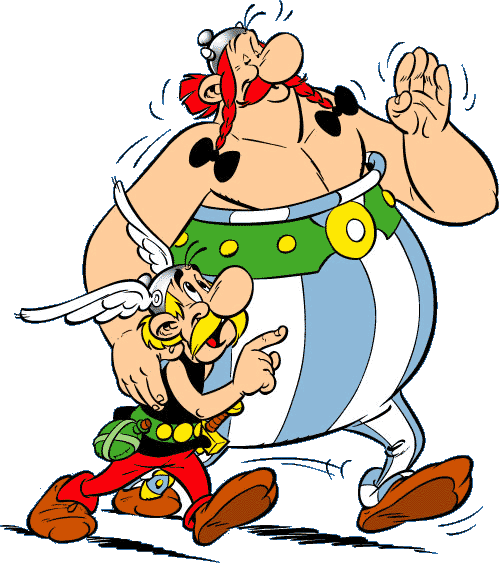
Asterix and Obelix
René Goscinny

Today is the birthday of René Goscinny (August 14, 1926 - November 5, 1977), author of the comic book series Astérix, following a village of indomitable Gauls as they resist Roman occupation. Goscinny was born in Paris but grew up in Buenos Aires. After the death of his father, he and his mother moved live with his uncle to New York. To avoid US military service, Goscinny returned to France and joined the French army in 1946, becoming an army illustrator. His first illustrated book, Returning to the US, he became friends with future MAD staffers Will Elder, Jack Davis, and Harvey Kurzman, and became art director for Kunen Publishers, writing children's books on the side.

He met the cartoonist Morris during this period, and starting in 1955, began a collaboration as writer of the series Lucky Luke, which he would continue until his death. Returning once again to Paris in 1951, he met his future Astérix partner Albert Uderzo and co-founded the Edipress/Edifrance syndicate. He worked on numerous projects, including Signor Spaghetti with Dino Attanasio, Monsieur Tric with Bob de Moor, and Prudence Petitpas with Maurice Maréchal. His first collaboration with Uderzo, Oumpah-pah, ran from 1958 to 1962.

Astérix first appeared in 1959, and 34 volumes have appeared since, with total sales in excess of 325 million copies. One of the most popular and beloved Franco-Belgian comics in the world, it has been translated into over 100 languages, adapted into 14 films, turned into numerous games, and even a theme park, Parc Astérix, near Paris. 

Lee Hoffman

SFFY cover by Steve Stiles
Lee Hoffman (August 14, 1932 - February 6, 2007), is perhaps best known as an author of Westerns, wining the Spur Award for her 1967 novel The Valdez Horses, which became a movie starring Charles Bronson and Jill Ireland. But she is also a beloved figure in science fiction circles, from her early days as a fanzine editor (Quandry, which ran from 1950 to 1953), where she was initially thought to be male — an understandable mistake given the overwhelming ratio of males to females in the science fiction community of the time. (Legendary Irish fan Walt Willis, upon learning the truth, immediately called Bob Shaw and shouted, "Lee Hoffman is a girl!")

She was married briefly to science fiction editor Larry Shaw, becoming assistant editor of his magazines Infinity Science Fiction and Science Fiction Adventures while also publishing her folk music fanzines Caravan and Gardyloo.

In addition to her seventeen Western novels, she wrote four science fiction novels: Telepower (1967), The Caves of Karst (1969), Always the Black Knight (1970) and Change Song (1972), and numerous short stories.

Brannon Braga

Star Trek:Enterprise
Television producer and screenwriter Brannon Braga co-created Star Trek: Enterprise and worked on numerous other properties in the Star Trek franchise. His other science fiction work includes Terra Nova, Threshold, and FlashForward. He also worked on the series 24 in its later seasons.

Miscellaneous Birthdays

It's also the birthday of Richard von Krafft-Ebing, Doc Holliday, Lina Wertmüller, David Crosby, Steve Martin, Danielle Steel, Gary Larson, Halle Berry, Magic Johnson, and Tim Tebow.

Tuesday, August 7, 2012

Nixon Resigns (Watergate Part 8)


“People have got to know whether or not their President is a crook. Well, I'm not a crook. I've earned everything I've got.”

— Richard M. Nixon, November 17, 1973

For previous installments of my irregular series tracing the history of the Watergate scandal, click here.  This week, Richard Nixon resigns the Presidency.

In our last thrilling installment, former Presidential assistant Alexander Butterfield revealed the existence of the heretofore secret White House taping system to the Senate Watergate Committee and to the world. In many ways, this revelation was the tipping point that inexorably led to the first — and so far only — resignation of a United States President.

Up until the tape revelation, much of the Watergate scandal had devolved into a “he said, she said” argument. There was no question that operatives associated with the Committee to Re-Elect the President (CRP to its supporters, CREEP to its enemies) had broken into the headquarters of the Democratic National Committee in the Watergate office complex, but it was less clear how high up the scandal might reach. After all, the idea that low-level staff members might take it into their own heads to do something the boss would not approve is hardly unprecedented.

The initial connection between the Watergate burglary and the Nixon campaign was James McCord, a former CIA operative who worked as a security coordinator for CRP. From there, it was a fairly short jump to reach McCord’s bosses. E. Howard Hunt, another former CIA agent, was also a modestly successful writer of spy thrillers. G. Gordon Liddy, a former FBI agent, had also been a prosecutor in Dutchess County, New York, where he famously busted 60s icon Timothy Leary. Both men were leaders of the White House Plumbers Unit.

Initially, a lot of people believed that the “two-bit burglary” itself was simply a rogue staff operation, and that the cover-up was primarily designed to protect the Plumbers operation. Although parts of the story remain murky to this day, it now appears that the burglary itself originated at high levels of the Administration, and may have been ordered by Nixon himself, concerned about potential negative information possessed by DNC chairman Larry O’Brien.

Slowly, the chain of Watergate responsibility crept up the ladder, moving from CRP to the White House itself, but the “smoking gun” that would implicate the President personally remained elusive. Senate Watergate Committee chairman Senator Sam Ervin of North Carolina pushed the essential question: “What did the President know and when did he know it?”

Although former White House counsel John Dean’s explosive testimony had in fact implicated Nixon, it was still a matter of his word against that of the President of the United States. The revelation of the White House taping system changed all that. The tapes themselves were capable of revealing once and for all what the President knew and when he knew it.

As revealed in our last installment, Butterfield revealed the existence of the White House tapes in a preliminary interview on Friday, July 13, 1973. The following Monday, June 16, he testified before the live, televised Senate Watergate Committee hearings and the tapes became public knowledge. Special Prosecutor Archibald Cox immediately asked District Court Judge “Maximum” John Sirica to subpoena eight relevant tapes that would confirm or contradict John Dean’s testimony.

Nixon, as noted, argued against the subpoena for two reasons. The first was executive privilege, a claim based on the separation of powers and checks and balances enshrined in the U. S. Constitution. The second was a claim that the privacy of the tapes was vital to national security. Nixon offered a compromise in which Mississippi Senator John Stennis would listen to the tapes and summarize them. When Cox refused, Nixon ordered what became known as the Saturday Night Massacre on October 19, 1973, and appointed a new special prosecutor, Leon Jaworski, on November 1, 1973.

The battle of the tapes continued to rage. In April 1974, the House Judiciary Committee subpoenaed the tapes for 42 additional White House conversations. Nixon released edited transcriptions, still citing executive privilege and national security. Jaworsky, about the same time, subpoenaed 64 tapes to support his criminal prosecutions of various Nixon administration officials. In late July 1974, the Supreme Court weighed in with an 8-0 decision in United States v. Nixon: the subpoena was valid. Nixon had to release the tapes.

In his column “On Language,” William Safire described Watergate as the Golden Age of Political Coinage. He wrote, “The Watergate era coined or popularized Saturday night massacre, stonewalling, cover-up, dirty tricks, straight arrow, expletive deleted, third-rate burglary, plumbers, Deep Throat, Big Enchilada, enemies list and twisting slowly in the wind.”

The term “smoking gun,” according to Safire, apparently first appears in the Sherlock Holmes story “The Gloria Scott,” but it gained its current meaning in the Watergate scandal. Roger Wilkins in the New York Times first used the term. “The big question asked over the last few weeks in and around the House Judiciary Committee's hearing room by committee members who were uncertain about how they felt about impeachment was ‘Where's the smoking gun?’”

On August 5, 1974, the House Judiciary Committee released what instantly became known as the “smoking gun tape.” It was a recording of a meeting that had taken place on June 23, 1972, six days after the original burglary, in which H. R. Haldeman, White House Chief of Staff, asked Nixon if he should ask Richard Helms, CIA director, to approach FBI chief L. Patrick Gray about halting his investigation on national security grounds. This, the special prosecutor and the Judiciary Committee agreed, constituted a criminal conspiracy to obstruct justice.

Here’s the relevant text:
HALDEMAN: …the Democratic break-in thing, we're back to the–in the, the problem area because the FBI is not under control, because Gray doesn't exactly know how to control them, and they have… their investigation is now leading into some productive areas […] and it goes in some directions we don't want it to go. […] [T]he way to handle this now is for us to have Walters [CIA] call Pat Gray [FBI] and just say, ‘Stay the hell out of this …this is ah, business here we don't want you to go any further on it.’”  
NIXON: All right, fine, I understand it all. We won't second-guess Mitchell and the rest. […] You call [the CIA] in. Good. Good deal. Play it tough. That's the way they play it and that's the way we are going to play it.”
Until that point, the ten Republican members on the House Judiciary Committee had voted against impeachment, but now they unanimously agreed that they would support an impeachment vote once the case reached the House floor.

In the American system, the impeachment of a President requires a simple majority vote of the House of Representatives, but removal from office requires a two-thirds vote of the Senate. In essence, this means that any removal of a President from office requires a substantial number of votes from the President’s own party. Impeachment can be a purely partisan act (see Clinton, Bill), but removal from office must necessarily be bipartisan.

It was therefore a delegation of Republican senators who informed President Nixon that there were only about 14 votes to keep him in office, far short of the 34 votes he needed. With the handwriting on the wall, Nixon took the only path available. In a nationally televised Oval Office address on the evening of August 8, 1974, Nixon resigned, saying:

In all the decisions I have made in my public life, I have always tried to do what was best for the Nation. Throughout the long and difficult period of Watergate, I have felt it was my duty to persevere, to make every possible effort to complete the term of office to which you elected me. In the past few days, however, it has become evident to me that I no longer have a strong enough political base in the Congress to justify continuing that effort. As long as there was such a base, I felt strongly that it was necessary to see the constitutional process through to its conclusion, that to do otherwise would be unfaithful to the spirit of that deliberately difficult process and a dangerously destabilizing precedent for the future…. 
I would have preferred to carry through to the finish whatever the personal agony it would have involved, and my family unanimously urged me to do so. But the interest of the Nation must always come before any personal considerations. From the discussions I have had with Congressional and other leaders, I have concluded that because of the Watergate matter I might not have the support of the Congress that I would consider necessary to back the very difficult decisions and carry out the duties of this office in the way the interests of the Nation would require. 
I have never been a quitter. To leave office before my term is completed is abhorrent to every instinct in my body. But as President, I must put the interest of America first. America needs a full-time President and a full-time Congress, particularly at this time with problems we face at home and abroad. To continue to fight through the months ahead for my personal vindication would almost totally absorb the time and attention of both the President and the Congress in a period when our entire focus should be on the great issues of peace abroad and prosperity without inflation at home. Therefore, I shall resign the Presidency effective at noon tomorrow. Vice President Ford will be sworn in as President at that hour in this office.
The next morning, the President and his wife said goodbye to the White House staff and boarded a helicopter to Andrews Air Force Base, where Air Force One waited to fly them to his California home in San Clemente. He wrote later of his thoughts. “As the helicopter moved on to Andrews, I found myself thinking not of the past, but of the future. What could I do now?”

President Gerald Ford pardoned Nixon on September 8, 1974, saying, “[Watergate] is an American tragedy in which we all have played a part. It could go on and on and on, or someone must write the end to it. I have concluded that only I can do that, and if I can, I must.”

Nixon continued to proclaim his innocence until his death on April 22, 1994.

Tuesday, July 31, 2012

True Grit


It was also at Corflu in a conversation about comic books when Dan Steffan mentioned he’d always been curious about GRIT, America’s Greatest Family Newspaper, advertised in most comics from the 1940s to the 1970s. “Boys!” screamed the headline. “Sell GRIT! Make money! Win prizes!”

“I used to sell GRIT,” I said.

People who know me as fairly introverted are somewhat surprised to learn about my background in sales. I not only sold GRIT, before Christmas I also sold greeting cards for the Cheerful Card Company, another comic book advertiser. For several years, GRIT and Cheerful Cards were the sole source of my spending money. GRIT sold for 20¢, and I kept 7¢. I could even strip the unsold copies and return them in lieu of payment.

My first experience in sales came from my brief days as a Boy Scout (I made it all the way to Second Class before I got kicked out for missing too many meetings — they conflicted with The Man from U.N.C.L.E. on Monday nights). There was an annual Scout Jamboree, and tickets were 50¢. If you sold 50, you got a free tent, and I sold about 65 or so. Some of the buyers gave me the money but declined to take a ticket, so I made a few extra bucks on the side as well.

I worked the concessions for a Shriner-sponsored event featuring the Flying Wallendas, a big act for small-town Decatur, Alabama, and moved a lot of merchandise. Somewhere I have an autograph of one of the Wallendas. So I was primed to Make Money and Win Prizes when GRIT came along.

GRIT was a weekly newspaper founded in 1882. Originally, it was just the Saturday edition of the Williamsport (PA) Daily Sun and Banner, but it was purchased in 1885 by a German immigrant named Dietrick Lamade, who built it up to a circulation of 20,000 within a few years. By the mid-1930s, circulation reached half a million.

GRIT wasn’t like other newspapers. Aimed at rural and small-town America, GRIT was a good-news newspaper. Here’s Lamade’s editorial policy:
“Always keep Grit from being pessimistic. Avoid printing those things which distort the minds of readers or make them feel at odds with the world. Avoid showing the wrong side of things, or making people feel discontented. Do nothing that will encourage fear, worry, or temptation... Wherever possible, suggest peace and good will toward men. Give our readers courage and strength for their daily tasks. Put happy thoughts, cheer, and contentment into their hearts.”
I liked GRIT for the extensive comics section, containing next Sunday’s comics. They were, unfortunately, in black and white, but I did get to read them several days early. (GRIT arrived Thursdays, and I sold them on Fridays.) A number of the strips weren’t carried in the local paper, the Decatur Daily at all: Mandrake, Prince Valiant, and Terry and the Pirates, among others.

As a salesman, my big advantage was that I had access to my father’s office building. He was a vice president of Mutual Savings Life Insurance, one of the largest companies in town. Mutual Savings occupied Decatur’s only skyscraper, towering six full stories over Bank Street. I started on the first floor and made my way up, and quickly reached a circulation of over 50 copies a week — more than $3.50 in income. I was a rich man; paperbacks cost 35¢ to 40¢, so I could buy five books a week with plenty of cash left over.

Most of GRIT’s customers were secretaries and clerks, many of whom I think actually enjoyed the “good news” paper. The executives on the sixth floor, I think, by and large bought it as a courtesy to my father, but that was okay by me. The fifth floor was most fun; it was home to WMSL Channel 23, the NBC affiliate and sole TV station in Decatur. The guys in the control room bought copies; the anchor of the evening local news bought a copy, and the kid show host, local legend Benny Carle, bought a copy. He did a publicity shot with me that appeared in an issue of the GRIT salesman newsletter, my first major media exposure.

I had a few customers not in the Mutual Savings building, so my mother would drive me around on Saturday mornings, then drop me off at the book-and-Hallmark Card shop where I’d pore through the limited selection of science fiction and get my reading fix for the week.

I sold GRIT for about two and a half years, starting in 1964, when I was in sixth grade, and continuing until the summer I started ninth grade, when I got a job as a page in the local library, where I worked for the great sum of $1.00/hour all the way through high school.

But that’s another story.

Tuesday, July 24, 2012

Let's Go to the Tape, Johnny! (Watergate Part 7)


Nixon secretary Rose Mary Woods demonstrates how she might have erased 18-1/2 minutes of a key Watergate tape.

For previous installments of my irregular series tracing the history of the Watergate scandal, click here. This week, the revelation of the White House taping system.

On July 16, 1973, as we learned in our last thrilling episode, former White House deputy assistant Alexander Butterfield revealed the existence of a heretofore secret White House taping system to the Senate Watergate Committee, more formally known as the Senate Select Committee to Investigate Campaign Practices. Two days later, on July 18, 1973, Nixon ordered the tape recorders turned off.

Unlike previous Presidential taping systems, the Nixon system was automatically activated by voice. Previously, the President had to manually activate the taping system by flipping a switch. Of course, no sensible president would voluntarily tape himself talking about potentially criminal actions, but in the case of Nixon, the automated nature of the tapes suggested that if he had indeed made self-incriminating statements, they would be on the tapes.

The previous month, former White House counsel John Dean had famously testified before the Watergate Committee. Although Dean himself had managed a large portion of the cover-up, he had increasingly suspected that he was being groomed as the scapegoat for the entire affair. As a result, he began providing information to the Special Prosecutor, and subsequently appeared before the Senate committee, implicating numerous senior administration officials including Attorney General John Mitchell and Richard Nixon himself.

The obvious flaw in Dean’s testimony was that it was his word against the President of the United States. But if the tapes confirmed what Dean was saying, it would substantiate his testimony. Accordingly, Archibald Cox, the Watergate Special Prosecutor, subpoenaed eight tapes.

Nixon initially refused to release the tapes, on the Constitutional grounds of executive privilege and the separation of powers, then added another claim that the tapes were vital to national security. In October 1973, under increasing political pressure, Nixon offered a compromise in which he would allow Mississippi Democratic Senator John Stennis to review and summarize the tapes, and report his findings to the Special Prosecutor.

When Cox refused the compromise, as chronicled in our last installment, Nixon ordered what became known as the Saturday Night Massacre. The pressure didn’t go away, and a few weeks later on November 1, Nixon appointed a new special prosecutor, Leon Jaworski. A few days later, on November 17, Nixon famously announced, “I am not a crook.”

As 1974 began, bad news for the Nixon Administration began to mount, and in April of that year, Nixon decided to release typed transcripts of the relevant tapes, from which the infamous phrase “expletive deleted” originated.

(As an aside, a friend of mine, the daughter of columnist Jack Anderson, told me how Anderson’s newspaper column got the transcripts before the Senate did. It seems that Anderson had a White House janitor on his payroll, who fished the single-use carbon paper out of the trashcans and delivered it to Anderson. The daughter, Laurie, taped the carbons to a lampshade and typed up the contents for her father.)

Meanwhile, the court case made its way to the Supreme Court. On July 24, 1974, in the case United States v. Nixon, ruled unanimously (with justice William Rehnquist recused because he had formerly worked for Nixon’s Justice Department) that the tapes should be released. Six days later, on July 30, Nixon complied. The transcripts confirmed Dean’s testimony.

The damage was already done. The House Judiciary Committee had passed two articles of impeachment already, with the third passed on the same day the tapes were released. To avoid a trial in the Senate that he would surely lose, Nixon resigned the presidency on August 8, 1974.