Tuesday, September 11, 2012

Propositional Fallacies, Part 1


There’s a branch of math known as propositional calculus that treats arguments like mathematical propositions. Using propositional calculus, you can demonstrate the truth or falsity of certain arguments.

Take the statement “It is raining here now.” Depending on when you make the statement, it can be either true or false. In propositional calculus, you’d represent the statement as “P,” and the opposite, “It is not raining here now” as “¬P.” If P is true, then ¬P has to be false; if ¬P is true, then P has to be false.

You can link together statements with connectors. Common connectors are AND, OR NOT, ONLY IF, and IF AND ONLY IF. If we say “It is raining here now, and it is raining where you are now as well,” we can label the second statement as Q. Represent AND with the symbol ⋀, and we can write “It is raining here now, and it is raining where you are now as well” as P⋀Q.

Of course, maybe it is raining here or it isn’t; maybe it’s raining at your house and maybe it isn’t. Because the individual statements can be true or false, we can prepare a truth table.

P                    Q                    P⋀Q
True         True            True
True         False              False
False             True            False
False             False           False

With and as a connector, the proposition P⋀Q is only true if both statements are true.

The connector OR (represented as “⋁”), on the other hand, makes the proposition true as long as at least one of the statements are true. “It is raining here now OR it is raining where you are now” results in the following truth table.

P                    Q                    P⋁Q
True         True           True
True         False          True
False          True              True
False           False             False

Notice that OR is used here inclusively rather than exclusively. That is, P doesn’t exclude Q from being true. If it’s raining at my house, that doesn’t mean it’s not raining at yours.

Given the idea of propositional logic, it's easy to conclude that there are fallacies to go with it. The first of these is known as affirming a disjunct.

Affirming a Disjunct

Also known as the fallacy of the alternative disjunct, or the false exclusionary disjunct, this particular fallacy occurs when you change an inclusive OR into an exclusive one. “It is raining here now or it is raining where you are now” gets interpreted as “If it is raining here now, then it isn’t raining where you are now.”

In our symbolic structure, that gets represented as the following argument (with “therefore” represented by ∴).

P⋁Q
P
∴¬Q

That’s a fallacy because it could be raining both places. One doesn’t preclude the other.

While OR in logic always means an inclusive “or,” that doesn’t mean you don’t sometimes want to be more concrete. The logical operator XOR is an exclusive or. When you use it, you’re saying “one or the other, but not both.” The symbol for that is ⊻.

More next week.

Tuesday, September 4, 2012

Who Was That Masked Man? (Formal Fallacies Part 3)


Formal fallacies are arguments that are always wrong, regardless whether the argument's premises (statements claimed as fact) are true or false. For example, in the appeal to probability, someone makes a claim that because something could happen, therefore it will happen. That’s false even if it's true that the something in question could indeed happen.

Masked Man Fallacy

I know who Bruce Wayne is.

I do not know who Batman is.

Therefore, Bruce Wayne is not Batman.

In the masked man fallacy, a substitution of identical designators in a true statement can lead to a false one. The statement "I do not know who Batman is" gets treated as if it excludes Bruce Wayne simply because I do know who he is. Of course, as long as I don’t know that Bruce is actually Batman, both statements can be absolutely true, and yet the conclusion does not follow logically.

The general form of the argument is:
X is known.
Y is unknown.
Therefore, X is not Y.
A similar argument, however, is valid.

Clark Kent is Superman (X is Z).

Batman is not Superman (Y is not Z).

Therefore, Clark Kent is not Batman (therefore, X is not Y).

That’s because being something is different from knowing something. Lack of proof of one proposition doesn’t serve as proof of the counter proposition.

Tuesday, August 28, 2012

Fallacy Fallacy (Formal Fallacies Part 2)


Formal fallacies are arguments that are always wrong, regardless whether the argument's premises (statements claimed as fact) are true or false. In the previous installment, the appeal to probability, a claim that because something could happen, therefore it will happen is false even if it's true that the something in question could indeed happen.

Argument from Fallacy

If an argument contains a fallacy, what does that say about the conclusion? Actually, it doesn’t say very much. Excessively pointing to fallacies can itself trigger a fallacy of its own: the argument from fallacy, or the fallacy fallacy.

The argument from fallacy is the error of concluding that if an argument can be shown to be fallacious, that means its conclusion necessarily must be false. The form of the argument is:
If P, then Q
P is a fallacious argument.
Therefore, Q is false.
Take, for example, the following claim: “I speak English, therefore I am an American citizen.” That’s a fallacious argument, because many people who speak English are not American citizens. To conclude, however, that because the argument is fallacious, you must not be an American citizen, is taking the claim a step too far. A conclusion can be right even if the argument supporting it happens to be wrong.

If you can show that a particular argument is fallacious, the only thing that means is that the particular argument can’t be used to prove the proposition. The opposite argument, that the fallacious argument itself disproves the proposition, is also a fallacy.

The argument from fallacy is also known as the argument to logic (argumentum ad logicam) and the fallacist’s fallacy. It’s part of a group of fallacies known as fallacies of relevance.

Base Rate Fallacy
Conjunction Fallacy

The base rate fallacy and the conjunction fallacy also fall into the category of cognitive bias, and were both treated earlier in this blog and in my compilation of cognitive biases, published separately.

Tuesday, August 21, 2012

How to Accomplish an Impossible Project


In my upcoming book Project: Impossible, part of Multi-Media's Lessons from History series, I lay out a methodology for dealing with a project that appears to be operationally impossible (that is, it can’t be accomplished within the initial boundaries of time, cost, and performance).


Other questions matter, too:


  1. What are the consequences of failure to meet the original requirements?
  2. Are there unacceptable negative consequences if we succeed?
  3. Could trying make things worse?
  4. How much risk should we be willing to take in achieving our goals?
  5. What are all the things that have to happen to allow us to call it success?
  6. How can we prepare our organization or team to be ready when the impossible project appears?


Except for number 6, the other questions can’t effectively be asked until you have the project (or hot potato as the case may be). And as we’ve seen time and time again on our historical journey, it’s what you do beforehand that often spells the difference between success and failure.

To do the impossible, it helps to be prepared. Preparation starts long before the impossible project swims into your field of view. Whether you and your organization will be able to rise to the challenge often depends on the strength and quality of your preparation.

In the television (and movie) series Mission: Impossible, the Impossible Missions Force (IMF, not to be confused with the International Monetary Fund) takes on challenges far beyond the capability of lesser organizations. How does it do that? First, it selects highly skilled people and provides training in the specifics of espionage. Second, it promotes a high degree of morale and esprit de corps. Members of the IMF see themselves as the best of the best.

Third, and possibly most important, the IMF enjoys a high degree of political support and cover for its operations — at least in the television series. In the case of the movies, it’s more often the case that the problem lies in their own management, and as a result, the movie plots normally involve the IMF team acting without the support of its covering organization. This makes the situation far more perilous, and if it weren’t for the magic of the motion picture experience, those projects more likely would turn out to be actually impossible.

Sometimes a project is impossible for a good reason. In other cases, the project isn’t what it seems. Practice looking at the situation through someone else’s eyes. Play the “what if” game. Look around you. Question the constraints.

And always accept that you don’t know everything.

Thursday, August 16, 2012

The Father of Science Fiction (Science Fiction Birthdays)

Hugo Gernsback

Hugo Gernsback (August 16, 1884 - August 19, 1967) was born in Luxembourg and emigrated to the United States in 1905. A television and radio pioneer, Gernsback founded radio station WRNY, participated in the first television broadcasts, and helped facilitate the development of amateur radio.

It was in the field of magazine publishing, however, that Gernsback would make his mark. His magazine The Electrical Experimenter, founded in 1913, primarily published nonfiction, but he also started publishing "scientific fiction" stories along with science journalism.

The reaction to these stories led Gernsback to found the first magazine dedicated to what he termed "scientifiction" (abbreviated "stf;" the term only survives as a joke among the science fiction cognoscenti): Amazing Stories, which began publication in 1926 and lasted (so far) until March 2005. (As a side note, I've been peripherally involved with Amazing twice, first because my good friend Ted White edited the magazine in the late 1960s and early 1970s, and again when my old employer TSR acquired the magazine in 1983.)

Amazing's letter column, which published the addresses of correspondents, triggered the beginning of organized science fiction fandom. Letter writers began to contact one another, form clubs, organize conventions, and start amateur magazines (fanzines) of their own. Although early fanzines tended to imitate their professional counterparts, fanzines quickly outgrew their "fan" origins to become an art form in themselves. (My own Random Jottings is a small part of that tradition.)

Gernsback himself was a controversial figure, accused of shady business practices and poor treatment of authors. (H. P. Lovecraft called him "Hugo the Rat.") He lost ownership of his magazines, including Amazing, in 1929, and founded two new magazines, Science Wonder Stories and Air Wonder Stories, which quickly merged into a single Wonder Stories, which he sold in 1936, returning once again in 1952 with Science-Fiction Plus, which lasted only a year. As an author, Gernsback is best known for the virtually unreadable (but seminal) novel Ralph 124C41+ ("One to foresee for one").

In spite of this, Hugo Gernsback is still credited for creating science fiction as a separate genre. To recognize this, the Science Fiction Achievement Awards, voted on by members of the World Science Fiction Society (aka the membership of the current Worldcon), are named the Hugo Awards. Gernsback himself received a special Hugo in 1960 as "the father of magazine science fiction."

Otto Messmer

Otto Messmer (August 16, 1892 - October 28, 1983) was an American animator best known for his work on Felix the Cat.

During his lifetime, the creative credit for Felix belonged to Pat Sullivan, whose studio produced the cartoons. After his death, Messmer claimed to have created the character. Sullivan Studio veterans and most comics historians support Messmer's claim.

Other SF Related Birthdays


August 16 is also the birthday of Regency novelist Georgette Heyer. Her books became popular among science fiction fans in the 1970s, to the extent that Regency-themed events were frequently held during science fiction conventions.

Julie Newmar is best known in science fiction and comics circles for her portrayal of Catwoman in the 1960s Batman television series. Her major science fiction credit, however, is her portrayal of Rhoda the Robot in the CBS sitcom My Living Doll, which ran for a single season in 1964-5. Bob Cummings played a psychologist responsible for teaching Android AF 709 how to be a "perfect" woman.

Director James Cameron produced numerous genre films, including the first two Terminator movies and most recently Avatar.

Other Significant Birthdays

August 16 is also the birthday of coach Amos Alonzo Stagg, Lawrence of Arabia, Menachem Begin, poet Charles Bukowski, Davy Crockett player Fess Parker, Eydie Gormé, Robert (I Spy) Culp, and Madonna.

Tuesday, August 14, 2012

The Drake Equation (Formal Fallacies, Part 1)

Frank Drake
In February, I completed a 25-part series on red herrings, a category of argumentative fallacies that are intended to distract from the argument, rather than address it directly. That's only one category of argumentative fallacy. In this series, we'll look at formal fallacies. Formal fallacies are errors in basic logic. You don't even need to understand the argument to know that it is fallacious. Let's start with the appeal to probability.

Appeal to Probability

If I play the lottery long enough, I'm bound to win, and I can live on the prize comfortably for the rest of my life! Yes, it's possible that if you play the lottery, you'll win. Somebody has to. The logical fallacy here is to confuse the possibility of winning with the inevitability of winning. Of course, that doesn't follow.

In our study of cognitive bias (also available in compiled form here), we learned that numerous biases result from the misapplication or misunderstanding of probability in a given situation. Examples include the base rate effect, the gambler's fallacy, the hindsight bias, the ludic fallacy, and overall neglect of probability. Use the tag cloud to the right to learn more about each. We are, as a species, generally bad at estimating probability, especially when it affects us personally.

Various arguments about the Drake equation can fall into this trap. The Drake equation, developed by astrophysicist Frank Drake in 1961, provides a set of guidelines for estimating the number of potential alien civilizations that might exist in the Milky Way galaxy. Here's the formula:


N = R^{\ast} \cdot f_p \cdot n_e \cdot f_{\ell} \cdot f_i \cdot f_c \cdot L


in which:
N = the number of civilizations in our galaxy with which communication might be possible;
R* = the average rate of star formation per year in our galaxy
fp = the fraction of those stars that have planets
ne = the average number of planets that can potentially support life per star that has planets
fℓ = the fraction of the above that actually go on to develop life at some point
fi = the fraction of the above that actually go on to develop intelligent life
fc = the fraction of civilizations that develop a technology that releases detectable signs of their existence into space
L = the length of time for which such civilizations release detectable signals into space
There are various arguments about the Drake equation. Some argue for additional terms in the equation, others point out that the value of many of the equation's terms are fundamentally unknown. There's a reasonable argument to be made that "N" has to be a fairly low number, on the simple grounds that we have not yet detected any extraterrestrial civilizations. Depending on the assumed values of the terms in the equation, you can derive conclusions that range from the idea that we're alone in the galaxy (see the Fermi Paradox) to an estimate that there may be as many as 182 million alien civilizations awaiting our discovery (or their discovery of us).

From a fallacies basis, however, the problem comes when people argue that the vast number of stars makes it certain that alien civilizations exist. As much as I'd personally prefer to believe this, the logic here is fallacious. Probable — even highly probable — doesn't translate to certainty.

That's not an argument against the Drake equation per se, but merely a problem with an extreme conclusion drawn from it. The Drake equation was never intended to be science, but rather a way to stimulate dialogue on the question of alien civilizations.

Science Fiction Birthdays

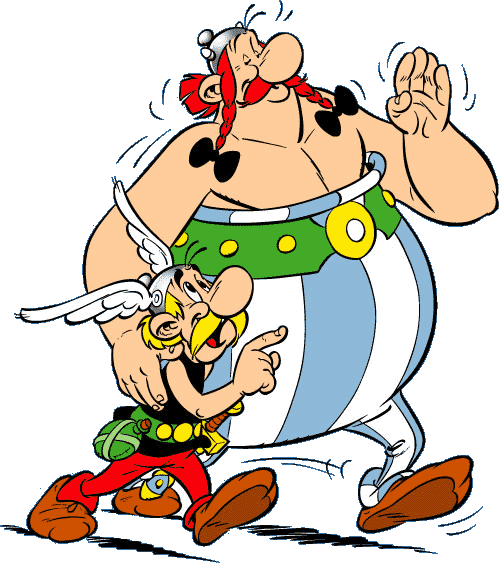
Asterix and Obelix
René Goscinny

Today is the birthday of René Goscinny (August 14, 1926 - November 5, 1977), author of the comic book series Astérix, following a village of indomitable Gauls as they resist Roman occupation. Goscinny was born in Paris but grew up in Buenos Aires. After the death of his father, he and his mother moved live with his uncle to New York. To avoid US military service, Goscinny returned to France and joined the French army in 1946, becoming an army illustrator. His first illustrated book, Returning to the US, he became friends with future MAD staffers Will Elder, Jack Davis, and Harvey Kurzman, and became art director for Kunen Publishers, writing children's books on the side.

He met the cartoonist Morris during this period, and starting in 1955, began a collaboration as writer of the series Lucky Luke, which he would continue until his death. Returning once again to Paris in 1951, he met his future Astérix partner Albert Uderzo and co-founded the Edipress/Edifrance syndicate. He worked on numerous projects, including Signor Spaghetti with Dino Attanasio, Monsieur Tric with Bob de Moor, and Prudence Petitpas with Maurice Maréchal. His first collaboration with Uderzo, Oumpah-pah, ran from 1958 to 1962.

Astérix first appeared in 1959, and 34 volumes have appeared since, with total sales in excess of 325 million copies. One of the most popular and beloved Franco-Belgian comics in the world, it has been translated into over 100 languages, adapted into 14 films, turned into numerous games, and even a theme park, Parc Astérix, near Paris. 

Lee Hoffman

SFFY cover by Steve Stiles
Lee Hoffman (August 14, 1932 - February 6, 2007), is perhaps best known as an author of Westerns, wining the Spur Award for her 1967 novel The Valdez Horses, which became a movie starring Charles Bronson and Jill Ireland. But she is also a beloved figure in science fiction circles, from her early days as a fanzine editor (Quandry, which ran from 1950 to 1953), where she was initially thought to be male — an understandable mistake given the overwhelming ratio of males to females in the science fiction community of the time. (Legendary Irish fan Walt Willis, upon learning the truth, immediately called Bob Shaw and shouted, "Lee Hoffman is a girl!")

She was married briefly to science fiction editor Larry Shaw, becoming assistant editor of his magazines Infinity Science Fiction and Science Fiction Adventures while also publishing her folk music fanzines Caravan and Gardyloo.

In addition to her seventeen Western novels, she wrote four science fiction novels: Telepower (1967), The Caves of Karst (1969), Always the Black Knight (1970) and Change Song (1972), and numerous short stories.

Brannon Braga

Star Trek:Enterprise
Television producer and screenwriter Brannon Braga co-created Star Trek: Enterprise and worked on numerous other properties in the Star Trek franchise. His other science fiction work includes Terra Nova, Threshold, and FlashForward. He also worked on the series 24 in its later seasons.

Miscellaneous Birthdays

It's also the birthday of Richard von Krafft-Ebing, Doc Holliday, Lina Wertmüller, David Crosby, Steve Martin, Danielle Steel, Gary Larson, Halle Berry, Magic Johnson, and Tim Tebow.